

FAQ
There are many brands of foils. Why choose Foil Attitude?
At least 10 good reasons:
1) Best value for money on the market: the performance of Foil Attitude foils is on par with the most expensive foils on the market. Our foils were designed by Maxime Nocher, 10-time world champion, mainly in kite foiling. Maxime is a talented expert who has mastered the design of foils (he is also the designer of Flymaax box wings). Our foils are on average 30 to 50% cheaper than the most expensive competing foils. In short, they are top of the range. The foils are made of “prepreg” carbon, which guarantees light weight and perfect impregnation of the fabrics.
2) Interchangeability. Everything is interchangeable: you can unscrew a beginner's front wing and screw on a racing wing instead: no adjustments needed! The same goes for the stabs: you can use any stab with any fuselage or front wing. No need to buy another foil to evolve and progress, everything is interchangeable, compatible, and upgradeable.
3) Versatility: wing, pump, or kite foil with the same foil.
4) Stability – ease: our foils are known for their ease of use and stability.
5) Solid construction, full carbon, protective reinforcements on the leading edge.
6) The range is easy to understand: all-purpose foils, no headaches when choosing which model to buy. Only foils that work are included in the catalog. We only sell top-of-the-line foils... In contrast, some brands offer a wide variety of foils. This is difficult to understand, even for specialists. In reality, some of these brands are trying to sell you as many models as possible, knowing that some models are completely outdated...
7) The foils do not saturate at high speeds and remain stable.
8) The most rigid aluminum mast on the market.
9) Rigid assemblies: no unwanted movements that could interfere with sailing and maneuvers.
10) Top-notch customer service renowned for its quality! Our customers appreciate the quality of our advice and after-sales service.
I'm new to wing foiling, which foil should I choose?
The Early Bird 1950 is suitable for a wide range of users. The Early Bird is very easy to use: it takes off easily and won't throw you out of the water if the wind picks up (unlike many foils, which become uncontrollable in strong winds).
Jibes are easier with the Early Bird: once in the air, it stays aloft at a speed of only 5 knots! This gives you time to perform maneuvers calmly.
The Early Bird 1490 is suitable for young people weighing less than 60 kg.
The Early Bird is the best foil on the market for learning to wing, for the reasons already mentioned, and above all because it performs much better (speed, stability, ease of use, very gradual takeoff) than the vast majority of beginner foils (whose design often dates back 5 years or more...).
If you later want to switch to a faster and even more efficient foil, simply replace the Early Bird front wing with an Ultra 1150 wing, for example. The transition is easy if you have already learned to fly with a foil. You can keep the EB485 rear stabilizer with the Ultra 1150, for example. You can keep the Early Bird front wing for very light winds, or contact us to trade in your front wing.
I am looking for a foil that I can use for both wing and kite foiling. Which foil would you recommend?
The Ultra 950 is the ideal foil for easy kite foiling in light winds (between 7 and 15 knots) and wing foiling in winds of at least 15 knots (or less if you have a tapered wing board or good pumping technique at the start).
The Ultra Wave 850 is also very good for kite foiling, but you will need 2 more knots to get started with wing foiling.
With the Ultra 700, performance will be very good for kite foiling (maximum speed above 30 knots), but it will be a little more technical for wing foiling takeoff compared to an Ultra 850 or 950.
Finally, for maximum performance in kite foiling and wing foiling, the Ultra Race 550 will be the ultimate weapon. You will be amazed by the Ultra Race 550: it starts quite easily when wing foiling. It will be easier than a Chubanga V3 (the foil used at the Olympic Games): easier to take off when wing foiling and faster. An experienced rider with good pumping technique will take off in just 13 knots with the Ultra Race 550!
You have several fuselages to choose from. Which one should you pick?
The standard fuselage is suitable for the vast majority of wing riders. It measures 63 cm and guarantees great ease and stability for the foil (regardless of the model). It is perfectly balanced to allow for pumping.
The wave fuselage is designed for expert wave riders who want a very playful foil. It is also a good idea to use a smaller stabilizer: W180, or even the brand new W130.
The wave fuselage can be used with the W130 stabilizer for pumping (dock start). It measures 58 cm and will allow you to pump a little faster than with the standard fuselage. When wing foiling, it will be a little more technical than the standard fuselage, especially in waves.
The freewave fuselage is recommended for those who kite foil or wing foil at high speeds, generally with the Ultra 700 or Ultra Race 550, and who are looking for maximum speed (over 30 knots). It is best used with the R210 race stabilizer for maximum directional stability and comfort at high speeds. On the freerace fuselage, the mast is moved forward by 3 cm for better control at high speeds. The fuselage measures 63 cm, the same as the standard fuselage.
If you're not specifically looking to pump and are more interested in controlling your trajectory at high speeds, go for the freerace.
Aluminum fuselage or carbon fuselage?
The carbon fuselage is twice as light as the aluminum fuselage.
The aluminum fuselage is recommended if you do freestyle (rotations, etc.) because it is very sturdy: you can “mistreat” it!
Aluminum mast or carbon mast?
The Foil Attitude aluminum mast is the stiffest aluminum mast on the market.
The carbon mast is lighter and even stiffer. The core of the mast is made of high-modulus carbon. This is one of its advantages.
The carbon mast is thinner than the aluminum mast, which already guarantees a higher top speed. The thinner the mast, the faster the foil will be. The impact on speed is considerable.
The carbon mast also offers better glide, as its profile is optimized. It does not whistle or ventilate. Thanks to Maxime Nocher, multiple world champion, who has designed a high-performance mast that is very pleasant to use with a very efficient profile. In contrast, the aluminum mast is manufactured “by the kilometer” by stamping. So its profile is basic compared to the profile of the carbon mast.
What is race preparation for the carbon mast?
The standard version of the carbon mast is varnished. The varnish gives it a beautiful finish. To achieve maximum speed, the varnish should be removed, leaving only the carbon. This provides a more efficient coating for water flow and reduces thickness, allowing you to gain a few more kilometers per hour.
It is also possible to prepare the front wing and stabilizer for racing.
I often ride with a wing on inland waters. Which foil(s) do you recommend?
If the wind is choppy and often light (which is most often the case on lakes), you can go for the Early Bird 1950 for its lift and easy takeoff, or one of the two Xtras 1450 or 1700.
The Xtra 1450 is an incredible foil that takes off very easily and very quickly (as quickly as an Early Bird 1950) and has impressive top speed and incredible glide. The Xtra is also great for pumping. When winging, a few pumps will allow you to keep flying in the lulls, which are quite frequent on a lake. Those who know how to dock start can use it for dock starts. Take Tom Balanca, for example.
The Xtra 1700 was designed for heavyweights who don't want to miss a single session. Some travel dozens or even hundreds of kilometers to sail. You might as well give yourself the best chance of sailing, so you don't get stuck on dry land like your friends. With the right board and technique, you can start sailing between 6 and 8 knots (!) with the Xtra 1700.
The Xtra is a foil that you will use 75% of the time on most lakes.
When the wind picks up (above 12/15 knots, for example), you can unscrew the Xtra front wing and switch to an Ultra 950 or 850. Or even smaller. So a combo of 2 front wings, Xtra + Ultra, will allow you to optimize all your sessions: light (or even very light) wind in summer and steady to very strong wind.
I practice wing foiling and only want to use one foil. Which one do you recommend?
If you only want one, go for the Ultra 1150. It has an excellent low range and is very easy to handle in strong winds.
If you only ride in winds of at least 12 or 15 knots, you can go for the Ultra 950 or the Ultra Wave 850.
If you want to practice SUP Foil, the Ultra 1150 is perfect and very easy in waves up to 1m or 1.20m (4 to 6 feet).
Which foil would you recommend for SUP foiling?
The Ultra 1150 is very easy in waves of 70 cm to 1 meter: it takes off easily and is easy to control.
In smaller waves, go for an Xtra.
If the waves exceed 1 meter and/or are hollow, go for an Ultra 950 or Ultra Wave 850.
Which foil and stabilizer do you recommend for pumping/dock starts?
There are three possible foils: Early Bird 1950 (beginner), Xtra 1450 (advanced), or Xtra 1700 (beginner). The Xtras will be faster than the Early Bird.
Stabilizer: all stabilizers work. The new W130 stabilizer is the most suitable.
What are aspect ratios?
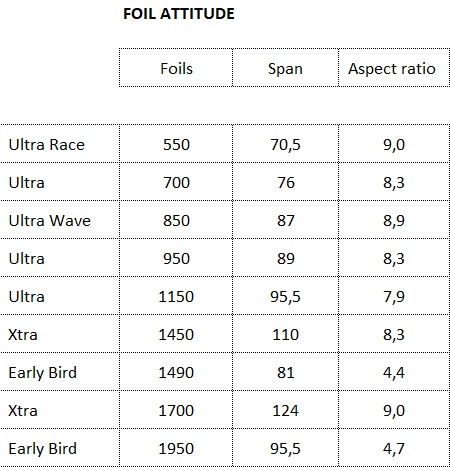
Please note: the aspect ratio of a foil is one of its characteristics. The aspect ratio is the ratio between the surface area of the foil and its wingspan. It is an important factor that will influence the behavior of the foil, particularly its glide, but it is not the only one. The profile of the front wing and the stabilizer are also very important... So be careful not to jump to conclusions based on what you read online...
Summary of aspect ratios:
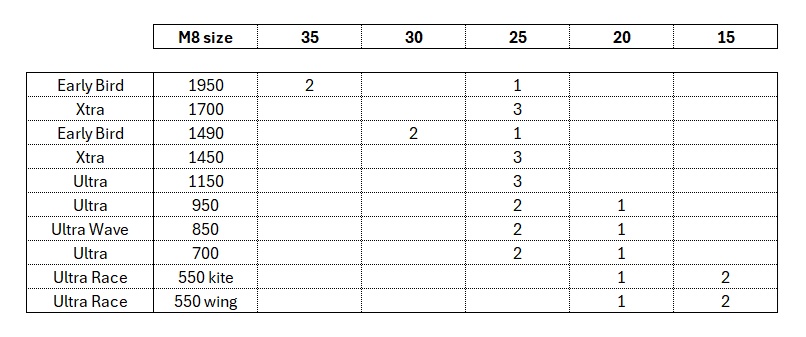
Which screws for which front wing?
Check out this table:
Can we try out Foil Attitude foils?
Yes, of course!
We regularly participate in events such as the Wing in Paris Festival, the Défi Kite / Défi Wing, the Foil'ie du Lac in Monteynard, the Foil in Serre Ponçon, the King of the Lake in Switzerland, etc. Come and give it a try! You can also check with our partner retailers to try out the equipment, such as The Ridery (Paris, Marseille, Almanarre), Welcome (Almanarre), Carnac Evasion, S-Bend Grenoble Monteynard, Opale Ride in Berck, Rid Air in Alsace, and more.
Other regions and abroad: contact us to be put in touch with an ambassador or rider.
Do your foils work with all wing boards?
Yes. In general, you just need to position the plate in the middle of the rails.
Do you need to use shims?
No, there's no need. The foils have been perfectly designed and all the components are interchangeable without any hassle.
Which foils do you recommend for parawing and downwind?
The Xtra 1450 and Ultra Wave 850 in particular. Otherwise all foils will do it too.